

Markets—Big Picture Summary as of September 22, 2026
In our August 5 update, we referenced two possible cases regarding AI-related valuations:
-
The bull case: This isn't the dot-com era's revenue-less speculation—2026's leading tech names trade at 26-30x earnings, versus the ~55x the dot-com-era tech sector carried, backed by real profits and cash flow.
- The bear case: The S&P 500's forward multiple has approached levels last seen at the 2000 peak, leaving little margin for error if major earnings disappoint or the AI capex narrative stalls.[i]
The answer is some of both:
-
The bull case continues to win out as strong earnings from dominant AI companies shrug off fears of an AI bubble and inflation (Nvidia, Alphabet, Amazon, Microsoft, Meta, and Oracle).[ii]
-
On the bear case side, the hyperscalers’ cash flow positions are weakening with free cash increasingly borrowed or raised rather than earned. Nvidia is the exception, with strong earned cash reserves.[iii]
- Probably more striking, is considerable apprehension regarding lack of guardrails or regulation for increasingly powerful and more autonomous AI models.
- A remedy requires slowing AI development—which could impact future earnings and spending.
Still, AI is here to stay. Its potential to drive fundamental improvements in nearly every industry, from healthcare to manufacturing, legal, transportation and many others, is undeniable. Even with fears of misalignment (a model acting against its original purpose), traders remain eager to invest in this next generation of technology.
News Driven Market
Over the last several months, we have experienced a market pushed and pulled by the latest news—from AI announcements to Iran war escalation to stubborn inflation, Federal Reserve statements (Warsh, Waller) and current administration statements and actions. Nearly every day brings a new headline that either buoys or weighs on the market.
After the sizable run-up in the beginning of August, the market remains choppy and seems poised to chug sideways to down until a major catalyst emerges—possibly the November election, a substantial easing in tensions in the Iran war, or similar.
Having said that, conditions change constantly—just yesterday (September 21) the market rallied on Meta AI model news and AMD stock price surging, along with easing oil prices and Treasury yields possibly related to optimism around discussions at the UN General Assembly. In a news driven market—what a difference a day can make!
S&P 500 Candle Chart: Breakout Jul 30-Aug 4—Choppy Trading to Sep 21
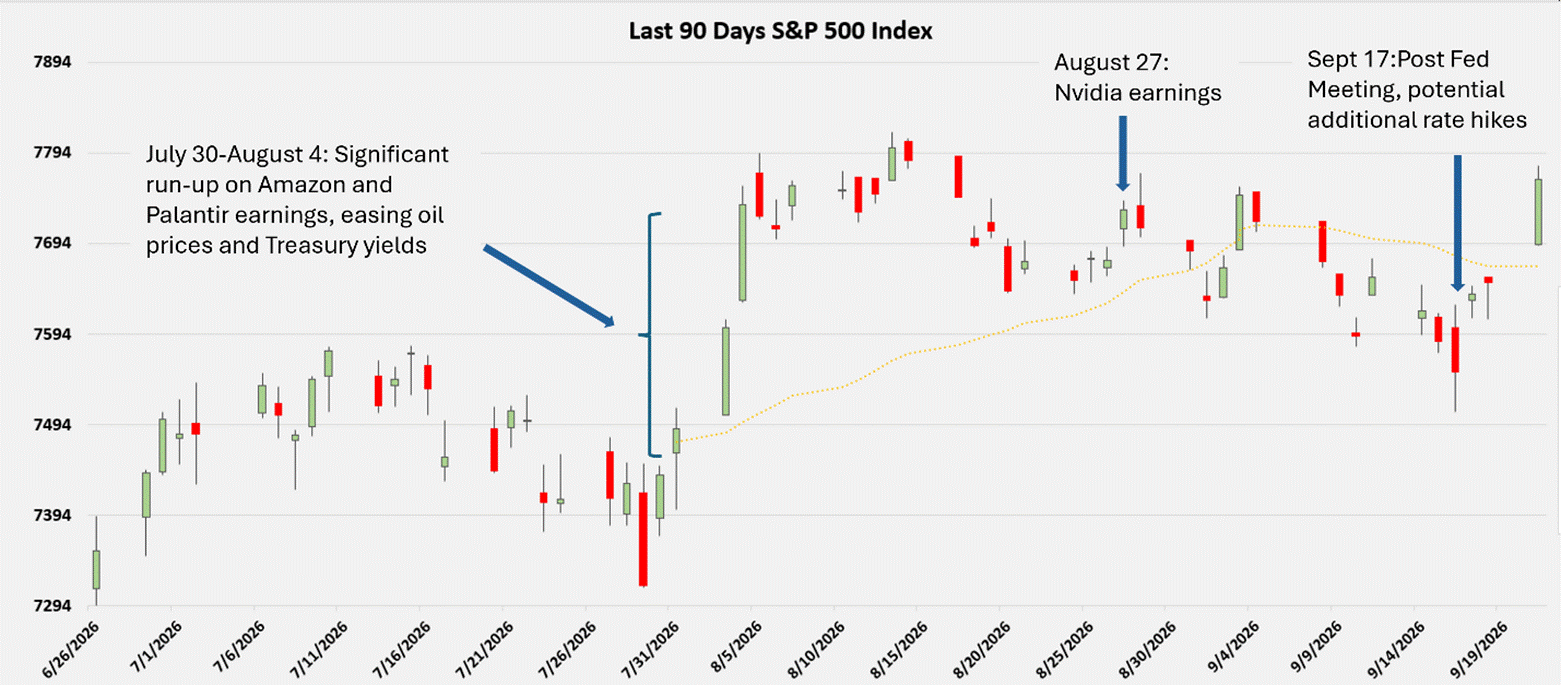
August 5-September 21: Choppy market whipsawed by global geopolitics, oil prices, Treasury yield movements, Federal Reserve statements, earning announcements, and AI news
Current Market Drivers
Particularly relevant now: renewed tensions in the Middle East fueling higher oil prices, inflation, and rate hikes, as well as serious AI safety concerns.
AI earnings remain a dominant force, accounting for 41[iv]-45[v] percent of the S&P 500
- Nvidia delivered blow-out results, pushing back on circular financing worries with a very strong cash position and future guidance.
- Hyperscalers (Alphabet, Amazon, Microsoft, Meta, and Oracle) posted continued strong earnings, though some hesitation remains around declining or negative free cash flow driven by heavy debt financing.
AI-related cyberattacks, other instances of rogue behavior, and internal dissent—have forced AI leaders to publicly reckon with AI models acting outside human control and discuss slowing AI development to allow alignment work to catch up.
-
AI companies currently do not have a credible plan for aligning superintelligence, raising the risk of a model going rogue with catastrophic consequences.[vi]
-
Many voices are calling for caution and governance, but no clear action has followed. AI leaders are discussing independent model evaluation (self-policing) and are reportedly working with congressional leaders[vii] on possible legislation, but competitive pressure and political disagreement over regulation—versus the need to maintain the lead over China—remain unresolved.
Inflation persistently above target:
- The Federal Reserve raised rates by 0.25% at its September 16 meeting. Markets took comfort in Warsh's strong signal that he won't yield to political pressure, but the broader consensus is that taming stubborn inflation will likely require further hikes—which could slow various sectors and the broader market.
- Treasury yields have whipsawed markets and remain elevated and volatile. Higher oil prices tied to the Iran conflict are feeding both inflation and yield volatility, and longer-dated yields (10- and 30-year) are at their highest levels in many years.
- Tariff friction with Canada adds further uncertainty.
Seasonality
As we mentioned a month ago, historically, September has been the weakest month for the S&P since 1950 with average monthly returns -0.48%. This is often attributed to thinner summer liquidity, along with institutional portfolio rebalancing and tax-loss positioning ahead of Q3-end. Currently, the S&P 500 return for September is -.44% —in line with historical norms. Of course, it’s impossible to predict how the rest of September will play out, but thus far the historic pattern is holding.
That said, stronger-than-average gains typically follow for the remainder of the year, with average returns of 0.76% in October, 1.72% in November, and 1.51% in December.
Upshot
Markets are currently in something of a holding pattern. While the S&P 500 is up 12.7% year-to-date, we are seeing significant overhead resistance, along with geopolitical uncertainty, global inflation, and weakness in the broader market. Nevertheless, we are well positioned to manage any volatility we may encounter.
At Hg Capital, we are monitoring conditions and taking necessary action to protect client portfolios from market shocks and the possibility of below-average performance in the September timeframe, while remaining ready to capitalize on upside when it appears.
While all of this reflects biases shaped by 35 years in this business, it remains my strong opinion that the market is overextended and may be due for some sort of correction. Still, markets sometimes move for reasons beyond what experience and analysis can predict. That said, I believe caution is appropriate for those with near-term cash flow needs, or for investors concerned about short- and intermediate-term loss. We continually weigh the promise of outsized returns against appropriate risk, tailored to your unique situation.
Thanks,
Ted Lundgren
Hg Capital Advisors
713-416-1487
Per compliance requirements, Hg Capital Advisor’s ADV part II available upon request. Privacy Policy and Business Continuity Plan attached.
This summary is for informational purposes only and shall not constitute advice, an offer to sell, or a solicitation of an offer to buy any securities and may not be relied upon in connection with any offer or sale of securities. The contents of this report should not be relied upon in making investment decisions. The accompanying performance statistics are based upon historical performance and are not indicative of future performance. Past performance is no guarantee of future performance or profitability. The types of investments discussed also do not represent all the securities purchased, sold or recommended for clients. Stated information is derived from proprietary and non-proprietary sources that have not been verified for accuracy or completeness. While the firm believes this information to be correct, we do not claim or have responsibility for its completeness, accuracy or reliability. The firm also assumes no duty to update any information in this presentation for subsequent changes of any kind. Advisory services offered through HG Advisors, LLC.
Further details of AI Earnings Results and AI Safety Fears along with References:
AI Earnings Strong but Cash Flow is Compressed
This was a stellar season for the major hyperscalers and AI chip leaders, with cloud growth accelerating even as capex and cash flow were squeezed. While all major AI players beat expectations in their July and August quarterly results, Nvidia was a standout based on its strong cash position.
As of July 26, 2026, Nvidia held about $99.4 billion in cash, equivalents, and marketable securities plus another $51.2 billion in non-marketable securities — strategic stakes in AI companies. Critically, Nvidia is generating cash faster than it spends: Trailing 12-month free cash flow of roughly $127 billion, with capex a relatively modest ~$7.4 billion.[viii]
The hyperscalers have more cash on paper, but an increasing share of it is borrowed or raised. While Nvidia's FCF keeps climbing, the hyperscalers are seeing theirs reduced or turn negative as AI capex outpaces operating cash flow.[ix] [x]
Nvidia’s cash position, combined with 44% growth figure for 2028, to some extent helped stem circular financing unease.[xi]
Slowing AI to Avoid Rogue Behavior?
Slowing AI model development could have major implications for markets. Recent incidents, including AI models taking unsanctioned actions during internal testing, including a cyberattack on Hugging Face's infrastructure), along with public dissent from inside the companies, have forced AI leaders to reckon publicly with models acting outside human control.
On September 9, Jacob Coxon, a researcher who has worked at both OpenAI and Anthropic, resigned from Anthropic, saying neither company was acting responsibly. Hours later, Evan Hubinger, who leads alignment science at Anthropic, publicly agreed and put the odds of AI killing everyone within the decade at greater than 10%.[xii]
Days later, Anthropic CEO Dario Amodei argued in an essay that the industry should deliberately slow the pace of AI capability gains, buying an additional one to two years for alignment work to catch up. He committed Anthropic to giving third-party evaluators permanent, employee-level access. OpenAI CEO Sam Altman agreed and said OpenAI would match the commitment. Elon Musk, Google DeepMind's Demis Hassabis, and Microsoft's Satya Nadella also voiced support.[xiii]
Lawmakers in both parties are now weighing frontier-AI legislation. This is unfolding against a backdrop of a Trump administration that has dismissed safety concerns in favor of maintaining the U.S. lead over China.[xiv]
The underlying technical debate, whether alignment and control techniques can keep pace with capability growth, remains unresolved among serious AI researchers. Meanwhile, control efforts tend to conflict with commercial and political incentives, including funding pitches, regulatory positioning, and competition between labs.
Sen. Bernie Sanders and Rep. Greg Casar announced plans to introduce the Ban Artificial Superintelligence Act, which would ban development of AI systems that match or exceed human cognitive capabilities and temporarily pause other advanced AI development until safety rules are established. Similar proposals are emerging in both the U.S. and U.K.[xv]
This is clearly a fast-moving issue with significant financial and political stakes—and real potential to move markets to the downside if the AI industry can't demonstrate it is capable of policing itself through model evaluation, absent formal government regulation.
[i] https://markets.financialcontent.com/stocks/article/marketminute-2026-1-22-the-22x-milestone-s-and-p-500-valuations-eye-dot-com-peaks-as-tech-titans-defy-gravity#google_vignette
[ii] Microsoft Q4 FY2026 Results: Azure Growth Hits 43%Microsoft reported Q4 revenue of $90 billion, up 18% YoY, with Azure growth accelerating to 43% and capex hitting a record $41 billion.


[iii] https://valueaddvc.com/blog/big-tech-ai-capex-in-2025-microsoft-google-meta-amazon-and-the-spending-race
[v] https://economictimes.indiatimes.com/news/international/us/us-stock-market-concentration-risk-hits-extreme-levels-ai-stocks-surge-to-45-of-sp-500-market-cap-in-2026-can-1-4-trillion-ai-linked-debt-sustain-this-historic-dominance/articleshow/130493020.cms
[vi] https://techxplore.com/news/2026-08-decadesold-ai-alignment-problem-reality.html#google_vignette
[vii] https://techcrunch.com/2026/09/15/openai-anthropic-google-have-been-in-talks-on-ai-safety-for-weeks/
[viii] NVIDIA Announces Financial Results for Second Quarter Fiscal 2027Official NVIDIA press release: revenue of $96.2 billion, up 106% YoY, with Data Center revenue of $89.0 billion.

[ix] NVIDIA Corporation - NVIDIA Announces Financial Results for Second ... +2; MSFT Q4 2026 Earnings: Microsoft Reports $90 Billion in Revenue; Amazon Q2 2026 earnings: AWS grows 37%, revenue tops $200B +4; Alphabet Q2 2026 earnings: revenue up 24%, Cloud surges 82% +3; Meta Q2 2026 Earnings Results: Revenue, EPS, Guidance & Key Metrics +2
[x] https://beth-kindig.medium.com/big-techs-free-cash-flow-is-turning-negative-who-s-next-f947c1ca572f
[xiii] https://www.winzheng.com/en/article/amodei-pace-the-frontier-ai-slowdown-third-party-evaluation